The Challenge
Salt Lab had built strong paid acquisition across Meta and TikTok. Meta traffic converted well on the website. TikTok was driving volume but wasn’t yet translating clicks into customers, with the website’s TikTok conversion rate running more than 97% lower than Meta’s.
The brand had the right creative and the right audience. What they hadn’t yet explored was whether the post-click experience could work harder. Whether matching the landing page to the specific ad angle would close the gap between the click and the checkout.
So they ran the experiment.
How Funneled Helped
Using Funneled, Salt Lab built a dedicated landing page for each ad angle. Same product, same audience, six different entry points. Each one picked up where the ad left off and carried that conversation all the way through to checkout.
The angles covered a range of hooks. Five were curiosity-led discovery angles and one was an urgency play:
Discovery / Hidden Insight
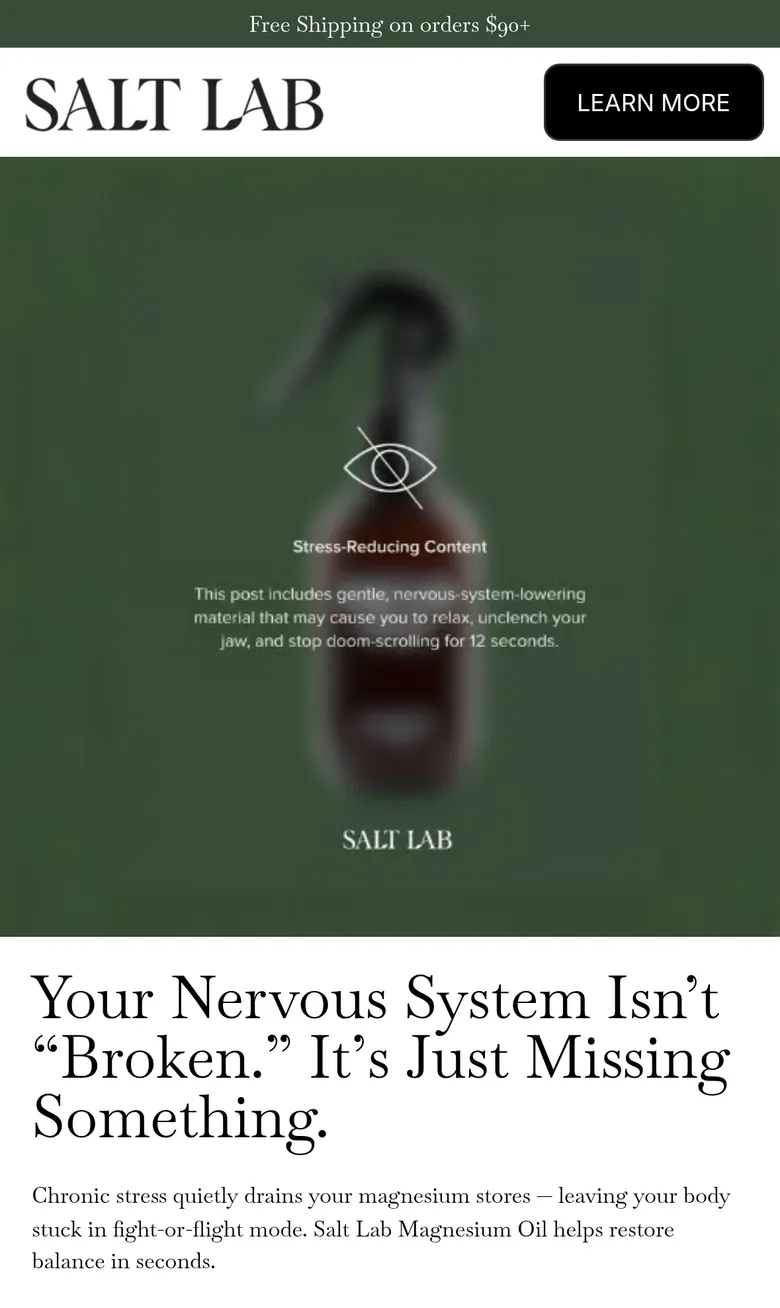
- "What is 'Nervous-System-Lowering Material' and How Can It Help You?"
- "What Happens When You Start Using Magnesium Before Bed"
- "10 Signs You're Low in Magnesium"
- "Your Vagus Nerve Is the Missing Link Between Stress and Recovery"
- "Wired but Tired / 3am Awake"
Scarcity / Deal
- "We Don't Do This Often"
The team iterated on each funnel throughout the month, publishing new versions as they refined copy, layout and offer structure. The question wasn’t whether funnels would outperform the website. It was which angle would win, and by how much.
The answer surprised everyone.
“10 Signs You’re Low in Magnesium” is the kind of hook that sounds like a sure thing. Broad appeal, proven listicle format, dead simple to understand. It underperformed the website’s Meta conversion rate by -68%.
“What is Nervous-System-Lowering Material?” reads like it’s too niche. Too clinical. The kind of hook you’d talk yourself out of in a planning session. It outperformed the website’s Meta rate by +41% and generated roughly 4x the orders from comparable traffic.
That gap is worth sitting with. The angle the room would’ve backed lost. The one that felt like a stretch ran away with it.
The Results
| Angle | Type | CVR vs Website |
|---|---|---|
| Nervous-System-Lowering Material | Discovery | +41% |
| We Don't Do This Often | Scarcity | +7% |
| Magnesium Before Bed | Discovery | +2% |
| 10 Signs You're Low in Magnesium | Discovery | -68% |
Best to worst discovery angle: a 5.4x difference in conversion rate. Same brand, same product, same audience. Just different words on the page.
The scarcity angle pulled its weight too, converting +7% above the website rate on solid volume. A completely different psychological lever, and proof that there’s room for more than one winning approach. But the top discovery hook still outperformed it by +32%.
Scaling didn’t kill the rate
Salt Lab pushed the winning funnel to 6x the session volume from its initial testing window. Conversion rate dipped just -21% at that scale. That’s a normal compression, and the sheer volume more than made up for it.
The basket got bigger too
The funnel didn’t just move more units of the core product. The post-purchase flow introduced customers to the wider range, and they bit. 10 different upsell products converted through the funnel, from bundles to creams to bath salts. Revenue per customer ran meaningfully above single-product pricing. None of that cross-sell existed in the standard website checkout.
The deltas
This wasn’t a story about funnels beating websites. It was a story about assumptions. The angle that looked safest underperformed. The one that felt too narrow won convincingly. And the conversion rate held when they backed the winner with real spend.
Salt Lab didn’t change their ads or increase budget. They gave the same traffic a landing experience that matched the promise of the click, and let the data tell them which promise resonated most.