
Advertorial landing pages for Shopify
An advertorial is a landing page that reads like an article. It starts with a problem the reader recognises, explains what causes it, and introduces your product as the answer partway down the page.
Shopify stores use advertorials for cold paid traffic: people who clicked an ad out of curiosity and are not ready for a product page yet. This page covers when the format fits, what goes on it, and how to build one in Funneled.

What is an advertorial landing page?
The word is a blend of “advertisement” and “editorial”. The page borrows the shape of an article: a headline that makes a claim or asks a question, a story or explanation in short paragraphs, and images or video that support the point.
The difference from a blog post is that every section moves the reader towards one product and one offer. The difference from a product page is the order. A product page leads with the product, price and buy button. An advertorial earns the reader’s interest first and shows the product once they understand why they might want it.
On Shopify, the advertorial usually either hands the reader to the product page or carries its own product section with add to cart, so the reader can buy without leaving.
When to use an advertorial
- Your ad sells a problem or an idea, and the click arrives curious, not ready to buy.
- The product needs explaining: an ingredient, a mechanism, or a new way of doing something.
- Sending the same traffic to the product page gets clicks but few add to carts.
- You have a real story to tell: a founder story, a customer’s experience, or an expert’s view.
When to use something else
- The visitor already knows the product, as with retargeting or branded search. A direct offer page is shorter and does the job.
- The product is simple and the price is low enough that a long read gets in the way.
- You would have to dress the page up as independent journalism. Say it is from your brand. Ad platforms and consumer law both expect advertising to be identifiable.
What goes on an advertorial
In the order a visitor meets them, top to bottom.
- 01
A headline that continues the ad
Repeat the claim or question the ad made, so the reader knows they landed in the right place.
- 02
The problem, in the reader’s words
Describe the symptoms or frustrations they will recognise. Short lists work well here.
- 03
Why it happens
Explain the cause plainly. This is the part a product page has no room for, and the reason the format exists.
- 04
The product as the answer
Introduce the product once the reader understands the problem. Show how it is used and what is in it.
- 05
Proof
Reviews, before-and-after images, or a comparison with the alternatives the reader has already tried.
- 06
One offer, repeated
A single call to action, placed after each major section and kept on screen on mobile.
How to build an advertorial in Funneled
A Funneled page is a stack of blocks. An advertorial uses the content blocks for the story and a product block for the offer, so the article and the buy button live on the same page.
- The Product block reads products, variants and prices from Shopify. Add to cart uses the funnel’s cart, and checkout happens on Shopify.
- If you want the advertorial to hand off to your store instead of selling on the page, use a Go To Website block. The click through is tracked as a destination.
- Build one advertorial per ad angle and duplicate it to test a different headline or opening against the first.
Every page is built in the same editor and connects to the same store. For how products, cart, checkout, testing and analytics work, see the Shopify landing page builder overview.
Advertorial example built in Funneled
A real page from a Shopify store, published with Funneled.
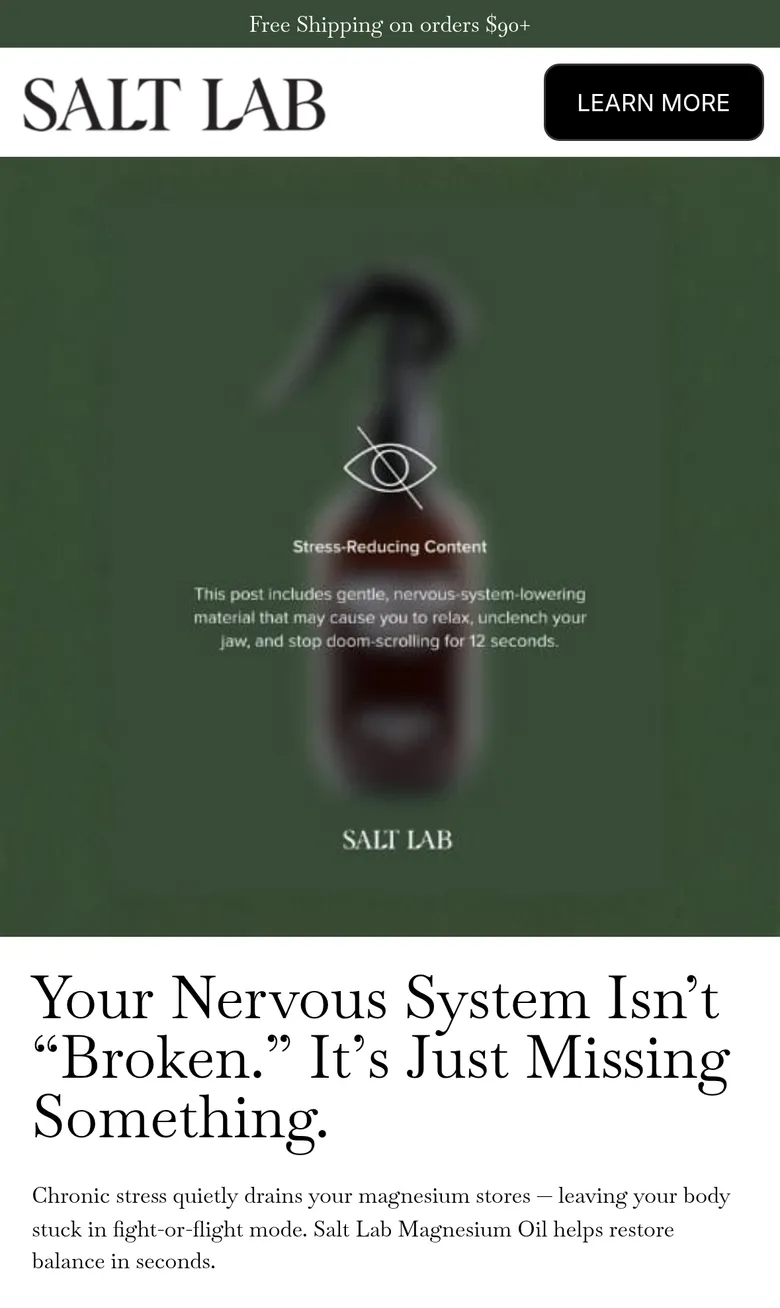
Salt Lab
Problem-first advertorial for a magnesium oil
The page opens on the reader’s problem, not the product: a headline about the nervous system, a list of symptoms, then an explanation of what stress does to magnesium levels. The product is introduced after that, as a starter bundle the reader can buy on the page.
Open the live Salt Lab pageWhat you’ll use to build and test it
Shopify landing page and funnel builder
The editor the blocks above live in.
A/B testing for Shopify landing pages
Test one headline or opening against another, or the advertorial against your product page.
Turn an ad into a matching landing page
Start the page from the ad creative so the headline and proof carry over.
Advertorial questions,
answered
An advertorial is one kind of landing page. A standard landing page leads with the product and the offer. An advertorial leads with an article-style story about the problem and introduces the product later. Both exist to get one action from the visitor.
Long enough to explain the problem, the cause and the product, and no longer. There is no fixed word count. If a section does not help the reader decide, cut it. Testing a shorter version against a longer one will tell you more than a rule of thumb.
Either works. Selling on the page removes a step. Linking to the product page keeps the advertorial purely editorial and uses the page you already have. In Funneled you can do both: add a Product block with add to cart, or a Go To Website block that sends the reader to your store.
An advertorial should be clearly from your brand. Do not present it as independent news or a third-party review. Ad platforms have policies on misleading landing pages, and most countries require advertising to be identifiable. Check the rules for the platforms and regions you advertise in.
Yes. In Funneled you assemble the page from blocks in a visual editor, connect it to your Shopify products, and publish it to a subdomain of your own domain. No theme code is involved.
Build your next advertorial
in Funneled
Book a demo and see how Funneled helps your team launch and test Shopify-connected funnels for paid traffic.